









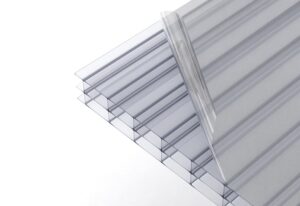
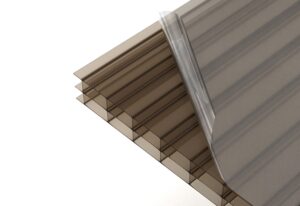
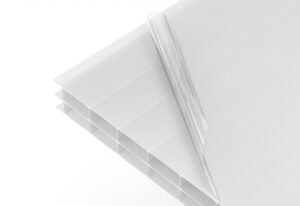
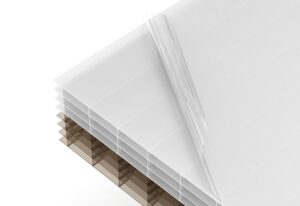


Choosing roofing sheets often starts with thickness, colour and price. UV protection deserves just as much attention. It affects how a sheet stands up to sunlight and, with polycarbonate, which way round it needs to be fitted.
Polycarbonate and PVC can both be suitable for outdoor use, but their protection is built into the products in different ways. Understanding the difference helps you choose the right sheets and avoid an installation mistake that could shorten their life.
At a glance: the standard multiwall polycarbonate supplied by The Polycarbonate Store is UV1, meaning a UV-protective layer on one surface. Our clear solid polycarbonate from 2mm to 12mm is UV2, with protection on both surfaces. Our 1mm and 1.5mm clear solid sheets are UV1. Outdoor-grade PVC uses stabilisers and other additives blended into the material to help resist sunlight and weathering.
1) Does polycarbonate block UV rays?
Polycarbonate naturally absorbs ultraviolet radiation, which means it can let useful daylight through while greatly reducing UV passing through the sheet. The exact transmission depends on the product, so check its technical information if you need a particular UV-blocking performance.
There are two separate points to understand:
- UV blocking: how much ultraviolet radiation passes through the sheet.
- UV resistance: how well the sheet itself withstands exposure to sunlight.
Absorbing UV does not make unprotected polycarbonate immune to weathering. The material also needs protection to help it retain its clarity and strength outdoors.
What does the UV coating do?
Outdoor polycarbonate sheets commonly have a thin UV-protective surface layer, often described as a coating. On the sheets discussed here, this is co-extruded during manufacture: it is made as an integral part of the sheet rather than painted on afterwards.
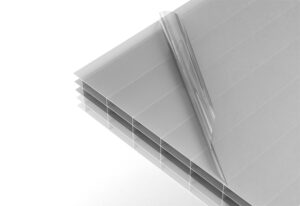
This layer helps limit UV damage to the polycarbonate, including yellowing and deterioration. It is different from the temporary protective film supplied for handling and installation.
2) What is the difference between UV1 and UV2?
UV1 means one surface has a UV-protective layer. UV2 means both surfaces have that layer.
These descriptions refer to the number of protected surfaces. They do not mean UVA and UVB, and UV2 does not mean twice the UV-blocking performance.
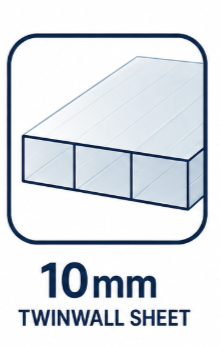
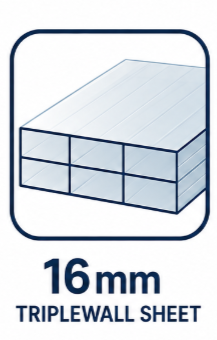
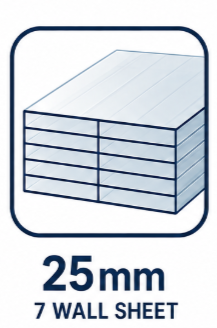
Twinwall and multiwall polycarbonate
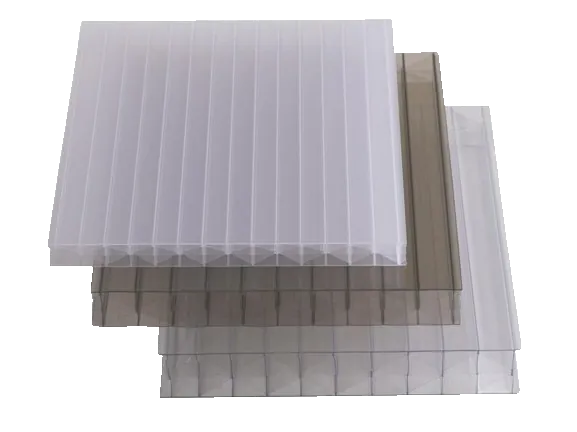
The standard twinwall and multiwall polycarbonate supplied by The Polycarbonate Store has UV1 protection.
The marked UV-protected surface must face towards the sun: upwards on a roof or outwards on external wall glazing.
Solid polycarbonate
Our clear solid polycarbonate sheets from 2mm to 12mm have UV2 protection, meaning both surfaces have a UV-protective layer.
Either surface can face the sun for UV protection, although you should still check for any other product-specific fitting requirements.
Our 1mm and 1.5mm clear solid polycarbonate sheets are UV1, so the marked UV-protected surface must face towards the sun.
UV protection varies between manufacturers and specialist grades. Always check the individual specification, particularly for textured, coated or specialist sheets.
Which surface of multiwall polycarbonate faces upwards?
The UV-protected surface must face upwards towards the sun. Identify it from the manufacturer’s printed film or markings before fitting.
Having protective film on both surfaces does not mean the sheet has UV protection on both surfaces.
If a UV1 sheet is installed upside down, its unprotected surface is exposed to sunlight. This can lead to premature deterioration and may affect a warranty claim.
3) Is PVC UV resistant?
Outdoor-grade PVC can be formulated to resist UV exposure. During manufacture, stabilisers and other protective ingredients are blended into the PVC compound to help it withstand sunlight and weathering.
This is the key difference from the co-extruded surface protection described for polycarbonate. With UV-stabilised PVC, weathering resistance comes from the material’s formulation rather than a separate UV1 or UV2 surface layer.
It does not mean every PVC product is suitable outdoors. Formulations are selected for particular uses, and an indoor PVC panel should not be assumed suitable for an exposed roof.
What about PVC roofing accessories?
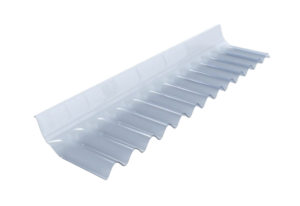
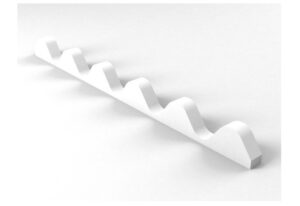
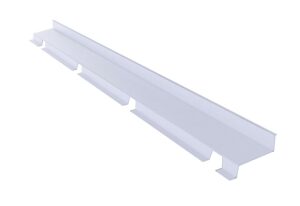
The same consideration applies to profiles and trims. Choose accessories intended for exterior roofing, including suitable PVC sheet closures, rather than substituting a general indoor trim.
UV resistance helps a product withstand exposure, but it does not make it immune to ageing. Product quality, installation, temperature, location and care all affect its service life.
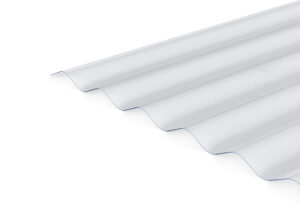
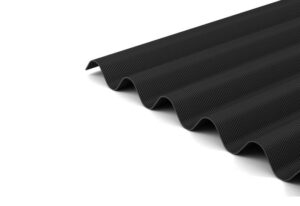
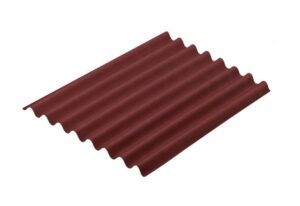
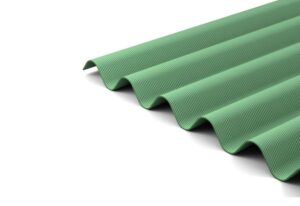
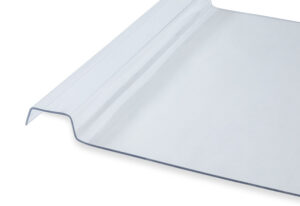
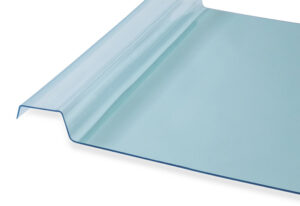
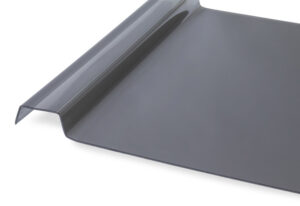
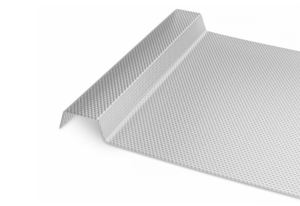
When choosing corrugated PVC roofing sheets, check the product description for its UV-stabilised specification and intended applications.
4) UV protection, daylight and heat are different
A roof can block UV and still let in plenty of daylight. It can also become warm underneath.
UV transmission, visible light transmission and solar heat gain are different properties, so a UV-protected sheet should not automatically be treated as a heat-control sheet.
When choosing a canopy or conservatory roof, consider how bright you want the space to be, how much direct sunlight it receives and how well it is ventilated.
If reducing heat build-up is a priority, compare the solar-performance figures for the available products, including our heat-control polycarbonate sheets.
Likewise, UV-stabilised PVC describes resistance to weathering; it does not, by itself, specify how much UV a clear PVC sheet transmits. Use the product data for that information.
5) Getting the installation and care right
A few checks before fitting can help prevent avoidable problems:
- Check the specification. Establish whether the sheet is UV1, UV2 or a PVC product with its own installation requirements.
- Identify the protected surface first. Check the printed film or markings before removing them.
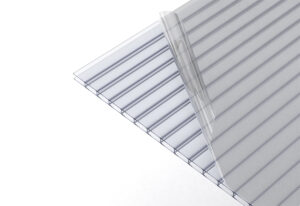
- Remove temporary film as instructed. It is packaging protection, not the permanent UV layer. Do not leave it on as an extra sun barrier.
- Protect the surface. Avoid abrasive pads, scraping and unapproved polishing products.
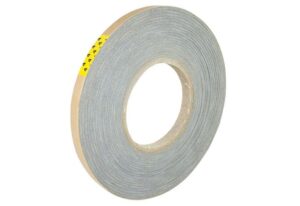
- Use compatible products. Check sealants, tapes and cleaning products against the sheet manufacturer’s guidance.
- Follow the complete roof specification. UV protection does not replace correct supports, drainage, fixings or thermal-expansion allowances.
For polycarbonate, use a soft cloth or sponge, lukewarm water and a suitable mild detergent, followed by a thorough rinse. Avoid cleaning in direct sunlight and never walk directly on the sheets.
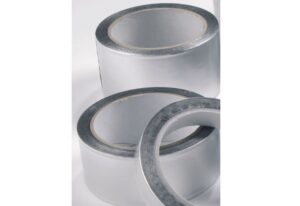
For multiwall roofs, correctly taped ends and closures matter too. See our sheet closure installation guide for help finishing the open flutes.
6) Choosing the right roofing sheet
Start with the structure you are covering, then compare sheet type, thickness, support requirements, light transmission, heat control and UV specification. A product being UV resistant does not make it suitable for every roof.
Explore our multiwall polycarbonate, clear solid polycarbonate and corrugated polycarbonate roofing sheets.
If you need help checking a specification, contact The Polycarbonate Store with details of your project.
7) Polycarbonate and PVC UV protection FAQs
Does clear polycarbonate block UV, or do I need a tinted sheet?
Clear polycarbonate can provide excellent UV blocking while allowing daylight through. A darker tint is not required simply to obtain UV protection. Compare the specification for UV transmission, brightness and solar performance separately.
Is UV2 better than UV1?
UV2 protects both sheet surfaces against UV weathering. That is useful where either surface may be exposed to sunlight. UV1 is suitable for many roofing applications when its protected surface is correctly positioned. The right choice depends on the product and application.
Are all solid polycarbonate sheets UV2?
No. The clear solid polycarbonate supplied by The Polycarbonate Store from 2mm to 12mm is UV2, but our 1mm and 1.5mm clear solid sheets are UV1. Other manufacturers and specialist products may have different specifications.
How do I identify the UV-protected surface after removing the film?
The UV layer is not normally something you can reliably identify by eye. Keep track of the orientation while fitting. If the markings have been removed and you are unsure, contact The Polycarbonate Store with the product details before installing it.
Does removing the protective film remove the UV protection?
No. The temporary film protects against handling damage. The co-extruded UV layer is part of the sheet and stays in place when the film is peeled away.
Does cutting a sheet remove its UV protection?
A normal saw cut does not strip the UV layer from the sheet surfaces, but the new cut edge does not gain a protective coating. Follow the manufacturer’s cutting and edge-finishing guidance. Multiwall ends also need the appropriate tapes and profiles.
Can PVC turn yellow or become brittle in sunlight?
UV stabilisers help reduce weathering; they do not prevent all ageing indefinitely. Choose exterior-grade PVC and follow its use and installation requirements. A product intended for indoor use may perform differently outdoors.
Does UV-stabilised PVC have a particular surface that faces upwards?
Blended stabilisers do not create the same one-sided UV layer as UV1 polycarbonate. However, the sheet profile, overlaps or other features may still determine its orientation. Always follow the particular product’s instructions.
Will UV protection stop furniture fading completely?
Do not treat UV blocking as a guarantee against fading. Exposure conditions, visible light, heat and the furnishings themselves also matter. An open-sided canopy can still admit sunlight around its edges.
How long do UV-protected sheets last?
There is no single lifespan for every polycarbonate or PVC sheet. Check the specific product warranty and its conditions. Correct installation and care help the material perform as intended, but a warranty period is not a universal service-life promise.
Do I need to paint on a UV coating after installation?
These exterior products are supplied with their specified protection built in. Routine care does not involve applying an aftermarket UV coating. Do not apply paints, films or treatments unless the manufacturer confirms compatibility.




Leave a Reply